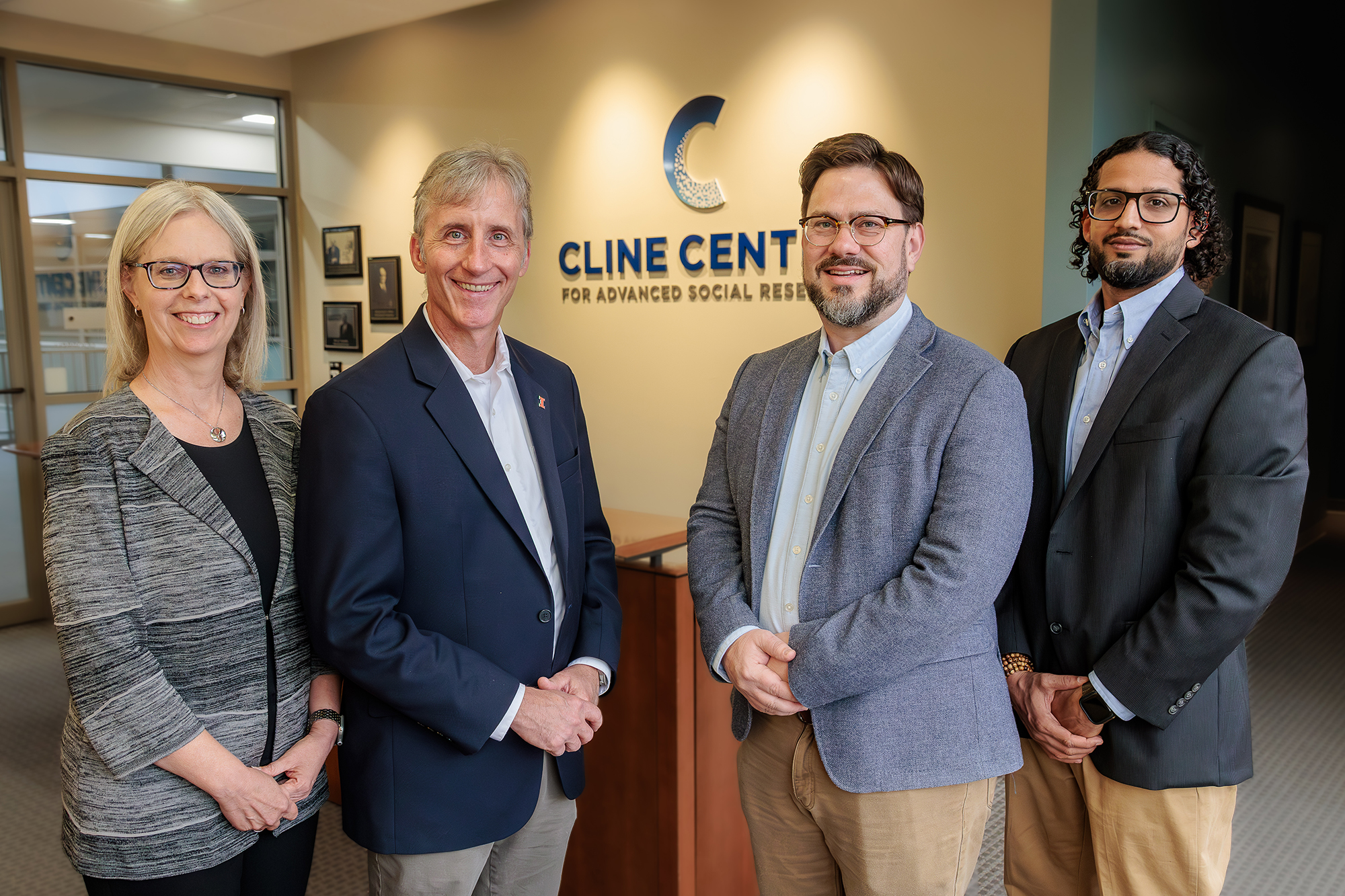
A new data-driven dashboard produced by the Cline Center for Advanced Social Research at the University of Illinois Urbana-Champaign uses predictive modeling to pinpoint U.S. counties that have unusually high or low numbers of police use of lethal force incidents relative to national benchmarks.
The Cline Center’s SPOTLITE project has compiled nearly a decade’s worth of data identifying police uses of lethal force across the U.S., making it the most comprehensive nationwide record available. It documents any law enforcement discharge of a firearm that risks human life, regardless of whether anyone was killed or injured, as well as any pursuit or other use of force that results in a civilian death.
SPOTLITE’s new “anomaly detector” feature will highlight parts of the country that may be in need of reform — or that might already be doing innovative things to reduce unnecessary uses of lethal force by police, said Scott Althaus, the Merriam Professor of Political Science at Illinois and the director of the Cline Center.
“SPOTLITE’s anomaly detector is the first national-scale resource for directing attention to counties with unusual numbers of lethal force incidents by police,” he said. “Up until now, there wasn’t a way to identify outliers, high or low, at a national scale. With the mountain of aggregated data our team has compiled through SPOTLITE, that’s enabled our researchers to do some modeling that can predict how many incidents we should expect to see in any given county.”
The interdisciplinary team of scholars and experts guiding the SPOTLITE project includes Althaus; Joseph Bajjalieh, a senior research manager at the Cline Center; Jay Jennings, the assistant director of research and a research scientist at the Cline Center; Michael Martin, a senior research coordinator at the Cline Center; Jennifer K. Robbennolt, the Alice Curtis Campbell Professor of Law at Illinois; Ajay Singh, the assistant director of strategic research initiatives and a research scientist at the Cline Center; and dozens of undergraduate and graduate student researchers who have worked since 2017 to compile the database.
Read the full story at news.illinois.edu.