Lawless quoted in Bloomberg on arbitration’s rising role in bankruptcy disputes

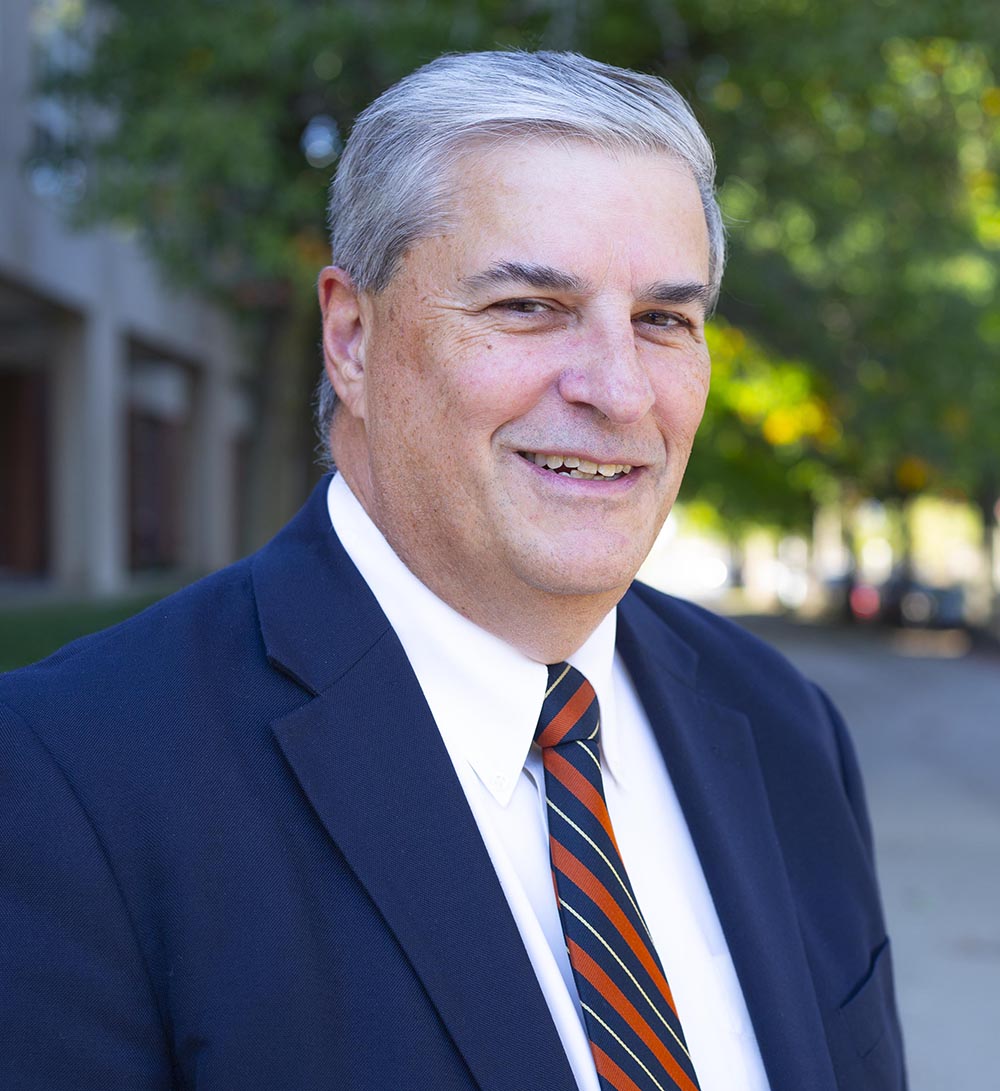
As consumer bankruptcy filings continue to rise, the role of arbitration has also increased. Because the Federal Arbitration Act and the US bankruptcy code can be at odds with each other and that tension has not yet been tested by the Supreme Court, experts expect that the matter will eventually make its way there.

Professor and bankruptcy expert Bob Lawless, who has written a paper on arbitration and bankruptcy, says that unless amended or repealed, courts should follow both statutes.

Speaking to Bloomberg, he said, “You’ve got to look and say, ‘For this matter in this arbitration agreement, is this subject to arbitration, and does the arbitral demand conflict with a command in the bankruptcy code?’”
How will SCOTUS ruling on Colorado conversion therapy law impact similar legislation in Utah? Wilson weighs in.

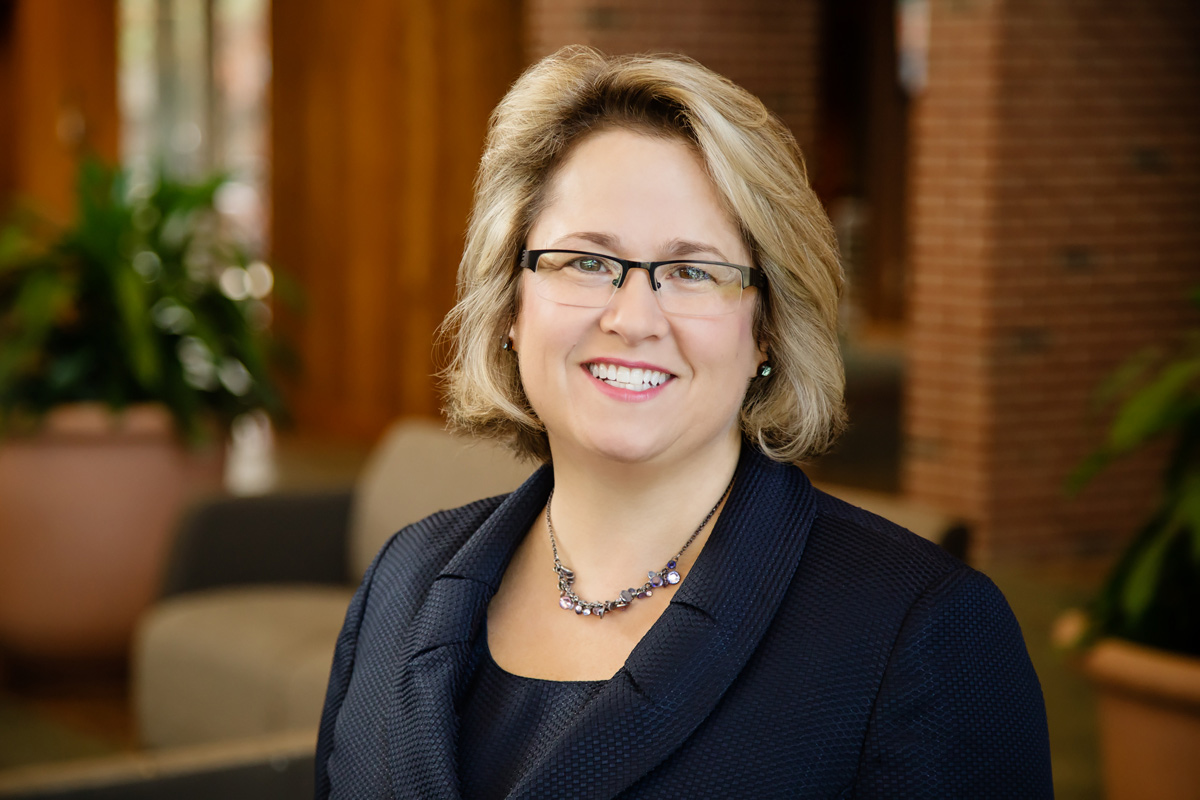
In late March, the Supreme Court issued a ruling in Chiles v. Salazar, overturning a Colorado law that bans conversion therapy for minors because it violates First Amendment protections on free speech. The ruling is expected to impact similar laws in many other states, but according to Robin Fretwell Wilson, Utah’s law may survive any legal challenges. She consulted with the state legislature on the language of its 2023 law banning conversion therapy and says that their approach differs, allowing neutral speech and banning harmful conversion practices.

“I think it’s remarkable that Utah has found a way through what has just been a slog with the rest of the country,” Wilson said. “We don’t have to be divided about these things that are so deeply personal to us, like our identity or how we choose to love. People, you know, can find a way to protect everybody in the same law.”

Read more at ksl.com, fox13now.com, and deseret.com.

College of Law congratulates 2026 Rickert Award recipients

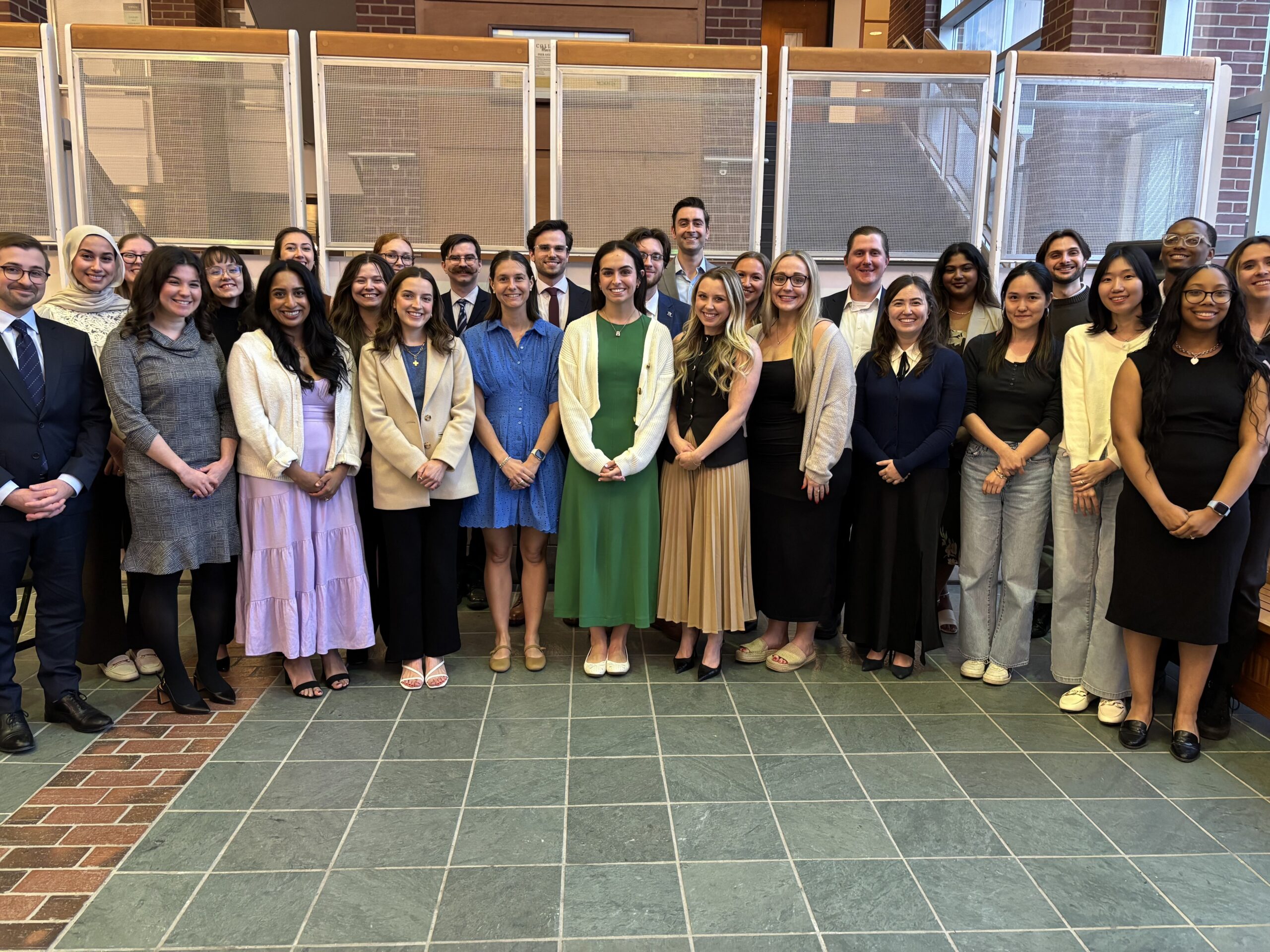
The Rickert Awards are the most prestigious awards conferred upon students at the University of Illinois College of Law and recognize excellence in student achievement. The Rickert Awards Program was established in the fall of 1976 and was named in memory of Joseph W. Rickert, a distinguished lawyer who practiced law in southern Illinois for many years. The Rickert gift paved the way for the College of Law to recognize outstanding third-year law students for their achievements. Congratulations to all of our 2026 honorees!

Excellence in Academic Achievement

Reilly Alridge
Kayla Beckley
Kendall Crispin
Emily Digman
Cole Edwards
Tanner Haynes
Daniel Morris
Ghazi Saoud
Elizabeth Walker

Excellence in Advocacy

Caroline Azem
Akanksha Balekai
Kelly Christensen
Sophia Downes
Ellie Jones
Ben Lee
Tyler Lewis
Jessie Randazzo

Excellence in Legal Writing

Jessica Bury
Sophia Downes
Willow Forster
Sieun Lee
Abby Milhiser
Brock Reeder
Avontay Ruff
Julia Sun

Excellence in Service

Lindsey Aden
Mounica Akula
Shaza Hussein
W Lander
Nurie Langlois
Abby Milhiser
Jess Nalupta
Alexandria Wilson

Tron Fu ’12

Tron Fu has joined as a partner Kilpatrick’s Patent Litigation Team in their Chicago office. Mr. Fu previously practiced at Dickson Wright.

Terry Bruce ’69

Terry L. Bruce of Olney passed away April 17, 2026, at Memorial Hospital, Springfield, Illinois, at age 82. From 1984 to 1992, Bruce served as U.S. Representative for the 19th Congressional District of Illinois.

William B. Moore ‘66

William “Bill” Moore, 85, passed away on April 12, 2026. Bill first served as a corporate attorney for Trans Union, then a holding company for the Union Tank Car Company. He went on to serve as corporate counsel, senior vice president, secretary, and general counsel with Chicago-based Whitman Corporation (formerly IC Industries) before retiring from Whitman in 1999. He is survived by his wife of 62 years, Barbara Matthys Moore, 3 children, and 8 grandchildren.

Keenan invested as Albert J. Harno Professor of Law

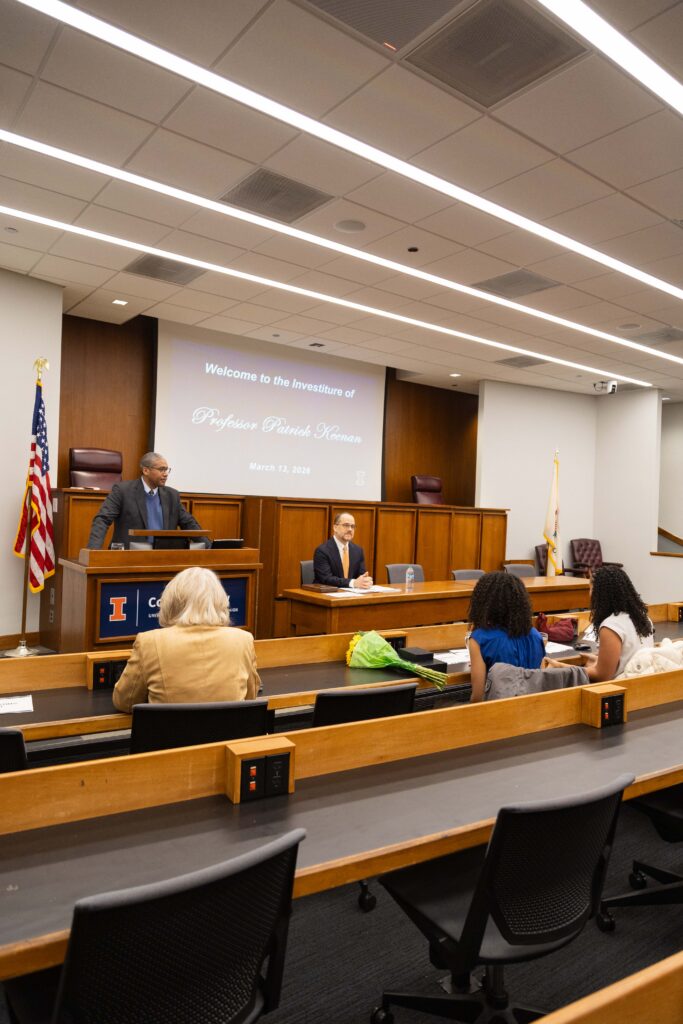
On March 13, 2026, Patrick Keenan was invested as the Albert J. Harno Professor of Law in a ceremony at the College of Law Building. In remarks shared at the ceremony, Dean Jamelle Sharpe quoted Professor Andy Leipold in designating Keenan as a pillar of the law school community: “Pat is a highly regarded voice in international human rights law; his careful, thoughtful scholarship has enhanced our international reputation, his teaching is terrific—just ask the students—and he has been a wonderful colleague, someone who is supportive and fair to all.”

Professor Keenan joined the University of Illinois College of Law faculty in 2001. He is an expert in human rights and international law, and he holds campus appointments not only at the College of Law but also at the Center for Global Studies, Center for African Studies, and the Lemann Center for Brazilian Studies. He has published articles and book chapters on a variety of issues, including the U.S. drone program, human trafficking and tourism, and international criminal law and conflict minerals, and he is the co-author of “The International Criminal Court in a Nutshell.” His work has appeared in leading law reviews, and he has been quoted in numerous prominent media outlets. Professor Keenan’s scholarship has also been cited in the United States Supreme Court and other federal courts. Prior to his time in academia, Professor Keenan defended indigent criminal defendants facing the death penalty in Georgia and Alabama at trial, on appeal, and in habeas proceedings as an attorney with the Southern Center for Human Rights. His full bio is available on his faculty profile page.

Professor Keenan’s endowed position was made possible through the thoughtful planning and a generous estate donation of Albert E. Jenner, Jr. ’30 in honor of Dean Harno. Dean Albert J. Harno served as a Professor of Law at the University of Illinois from 1921-1957 and was the dean of the College from 1922-1957, overseeing the College’s move from Altgeld Hall to the current College of Law building in 1955. At the campus level, he served as University Provost from 1931-1944.  Dean Harno was also one of the leading scholars in the field of criminal law, producing a critical chapter entitled “The Supreme Court, In Felony Cases” in the 1929 Illinois Crime Survey, along with bringing forth the texts, “Sentencing and Parole in Illinois” and “Cases and Materials on Criminal Law and Procedure.” 

Jamelle Sharpe delivers remarks during Pat Keenan's investiture ceremony.
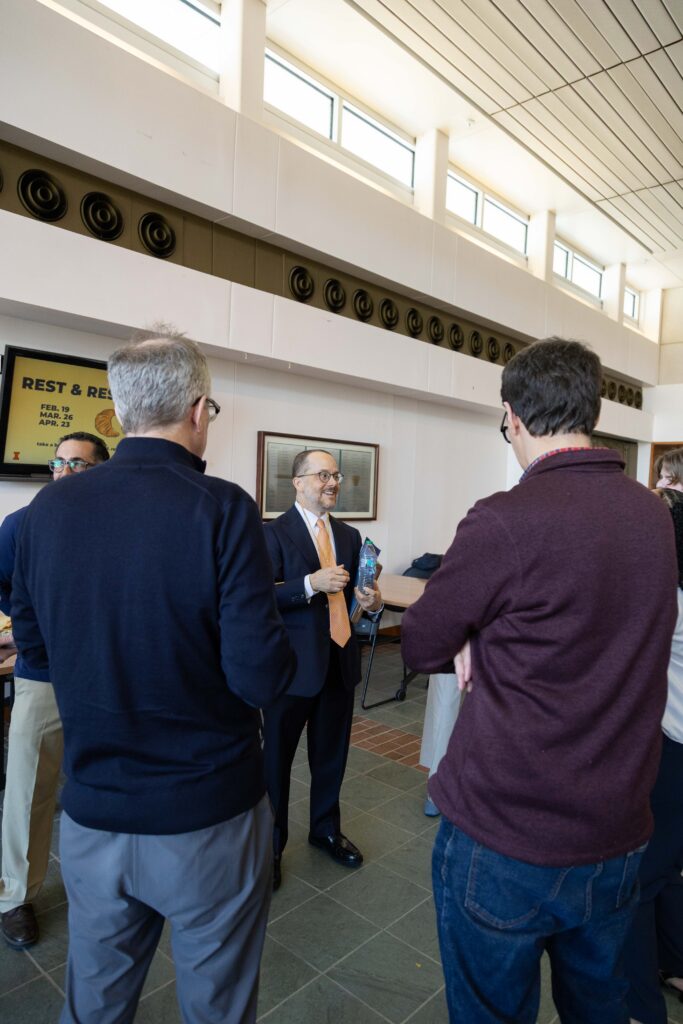
Colleagues congratulate Professor Keenan following his investiture ceremony.

Is Utah’s first-in-the-nation pilot program allowing AI to renew prescriptions legal and ethical?

Utah has introduced a first-in-the-nation pilot program that allows AI to independently renew certain prescriptions for patients with chronic conditions. The 12-month initiative, which launched in January 2026, uses an AI system developed by the health tech company Doctronic, and operates under a special state “regulatory sandbox” designed to test emerging technologies. A New England Journal of Medicine (NEJM) article, authored by Sara Gerke, Ravi B. Parikh, and I. Glenn Cohen, raises serious questions about its efficacy and legality.

The program currently applies to nearly 200 commonly used medications, including treatments for conditions such as high blood pressure, diabetes, and depression. State officials say the goal is to improve medication adherence. After an initial review period of 250 cases by a physician, the AI system will begin making prescription renewal decisions without direct human oversight.

While the authors agree that “autonomous prescription renewal may offer benefits in narrowly defined clinical contexts,” they focus on several medical and legal issues raised by the program, including:

  • Risks when the system is used for medications requiring frequent dose adjustments or in patients whose clinical status could change rapidly.
  • Whether Doctronic problematically failed to seek FDA premarket authorization for the AI system as a medical device.
  • Whether AI-based prescribing is an instance of “misbranding” carrying potential civil or criminal penalties, because prescribing must be done by “a practitioner licensed by law to administer such drug.”

The article also discusses the complex relationship between state and federal law at play in such autonomous AI systems. “Such systems hold a lot of potential benefit for patients,” said I. Glenn Cohen, a Professor and Deputy Dean at Harvard Law School and one of the article’s authors, “but especially as the first-in-the-nation, it is important for patients that the developers consider all the legal and ethical issues raised.”

Wilson op-ed: Protecting speech, not encroaching on it, is the better way to serve children

Following the Supreme Court decision in Chiles v. Salazar, which found that a Colorado law banning conversion therapy for minors violated the First Amendment rights of therapists, Professor Robin Fretwell Wilson co-authored an op-ed (with Utah state legislator Mike Petersen) for Deseret News.

The pair wrote that they don’t believe the ruling will impact Utah’s own law banning conversion therapy. An excerpt follows:

“Unlike Colorado’s law, Utah’s legislation is viewpoint-neutral. Rather than dictating conversation, Utah’s law protected virtually everything a therapist would want to explore with a minor client through “safe harbors.” Therapists can talk with kids about body image, family dynamics, social media use, religious beliefs or risky behaviors — and children can raise doubts, fears or questions — without being funneled into a single script of affirmation. Destructive aversive practices remain banned — but dialogue, exploration and honesty are protected.”

Mazzone quoted in NYT after SCOTUS hears oral arguments in birthright citizenship case

Following oral arguments in Trump v. Barbara, most legal experts agreed that although the Supreme Court will most likely decide against the government, the justices’ treatment of the Trump administration’s position lends it respectability and could ultimately allow Congress to return to the question of birthright citizenship.

Professor Jason Mazzone, constitutional law expert, expected far more aggressive questioning of both sides. Speaking to the New York Times, he said, “I kept having to remind myself that I was listening to a Supreme Court oral argument rather than presentation of papers at an academic conference before a polite audience of scholars willing to engage with whatever eccentric idea was being presented.”

“My conclusion from the content and tone of the argument is that there is a majority — possibly even nine justices — already persuaded that the executive order violates the 1952 statute,” he said, “and so the 14th Amendment argument didn’t need the sort of probing that would be required in another case that turned solely on a constitutional issue.”

College of Law
504 East Pennsylvania Avenue
Champaign, IL 61820
(217) 333-0931