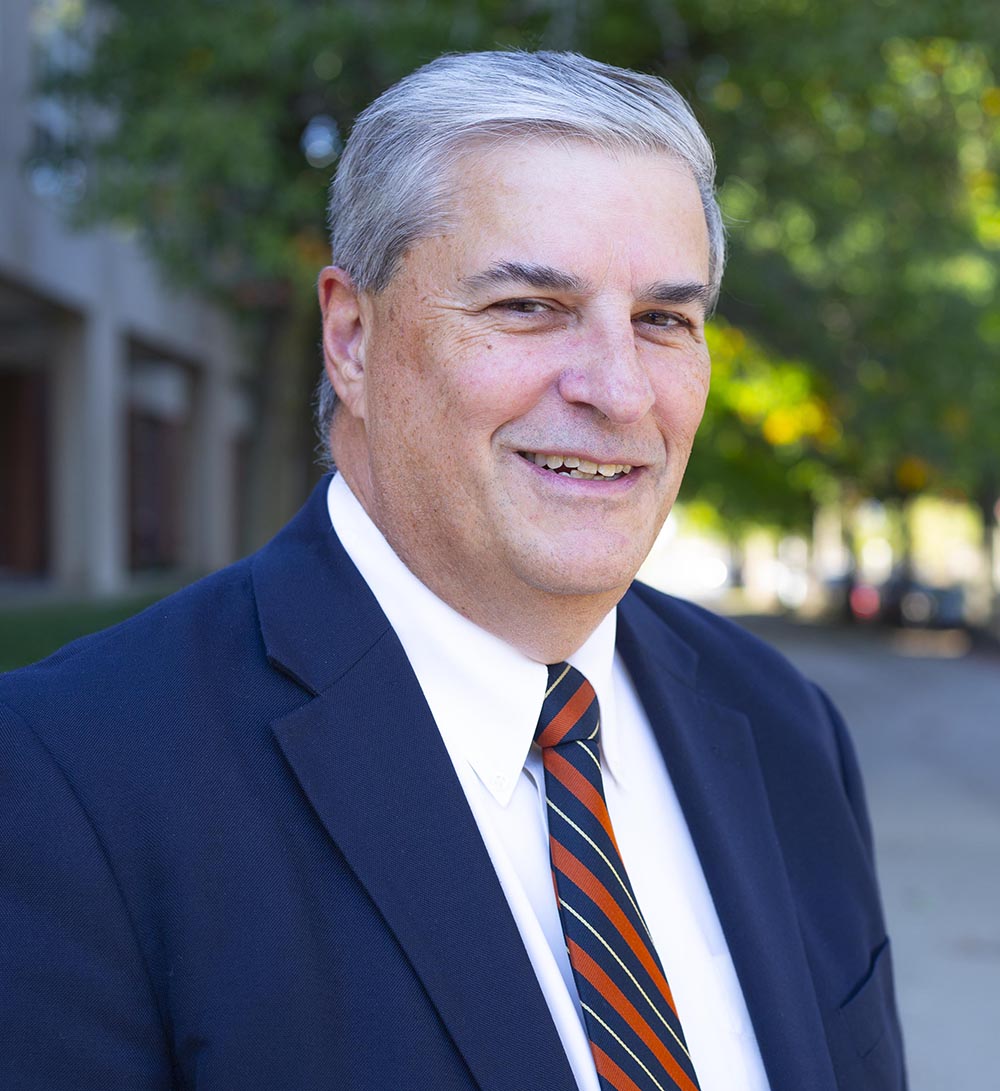
Ghiotto shares his story with Young Lawyers Podcast

From law student to the battlefields of Afghanistan and back to the classroom, this time as a professor, Anthony Ghiotto has blazed a unique path to the College of Law. On the American Bar Association’s Young Lawyer Rising podcast, he shared his story of joining the Judge Advocate General’s corps after graduating and the wealth of experience he earned as part of the military. Hear more about how his struggles and triumphs helped him get to Illinois, where he serves as teaching assistant professor and director of the Kimball R. and Karen Gatsis Anderson Center for Advocacy and Professionalism and trial advocacy.

Multiple outlets quote Brubaker on Purdue Pharma Supreme Court case

The bankruptcy deal for Purdue Pharma, in which the Sackler family would pay $6 billion and be shielded from further lawsuits, is a highly charged issue which led to fiery arguments before the Supreme Court. Professor Ralph Brubaker, who has submitted an amicus brief against Purdue Pharma in the case, spoke with several news outlets recently on the particulars of the case. “You can’t just impose settlements on people without their consent by virtue of the vote of other claimants,” he told the BBC. Read more in the articles linked below. 

Thomas wins CAAM Ready, Set, Pitch contest

Professor Suja Thomas’s documentary worked received another boost this fall when she was announced as the winner of the annual Ready, Set, Pitch! contest. Put on by the Center for Asian American Media, the contest showcased diverse Asian American storytelling from emerging documentary filmmakers from the Midwest and South. Thomas’s as-yet-untitled documentary on the U.S. court system and the importance of democracy was awarded $10,000 in support from the John D. and Catherine T. MacArthur Foundation, which will help her complete her project. This honor follows a year-long CAAM Fellowship for Thomas, which paired her and other fellows with established professionals in the field.

Sherkow co-authors new article on telehealth

Professor Jacob Sherkow is a co-author on a new paper published by the National Academy of Medicine examining the rise of telehealth and the digital transformation of healthcare. The discussion paper is part of a new NAM Perspectives series explores emerging science and technology applications in order to better understand, anticipate, and develop governance for future development, with special attention to their potential societal, ethical, legal, and health-related impacts. Sherkow’s article examines the roles of state, federal, and regional regulations, as well as governance challenges in an increasingly online and interconnected living environment.

Read the full paper from the National Academy of Medicine.

Brubaker in Bloomberg: Purdue Confronts Supreme Court Skeptical of Bankruptcy Power

In the lead-up to oral arguments in the Purdue Pharma case at the Supreme Court, bankruptcy expert and law professor Ralph Brubaker spoke to Bloomberg about the key question at hand.

“Given the court’s existing jurisprudence, I would be personally shocked if they find there is statutory power for what the bankruptcy court approved in the Purdue case,” said Brubaker, who filed an amicus brief against Purdue in the case.

Johnson quoted in NY Times and USA Today on trial of Highland Park shooter’s father

The father of the shooter at the Highland Park 4th of July parade pleaded guilty to seven counts of reckless conduct earlier in November, signaling that it is possible to hold family members accountable in similar cases. Professor Eric Johnson, a criminal law expert, spoke to the New York Times and USA Today about the case. Referring to the charges against the father in the case, Johnson said, “It’s a relatively novel — though I think defensible — theory of prosecution.”

While prosecutors are not changing the law or what it means to act recklessly, they are identifying new situations where they might apply it, he said.

More at nytimes.com and usatoday.com

Brubaker amicus brief in Purdue Pharma case featured on Harvard Law School Bankruptcy Roundtable

The Harvard Law School Bankruptcy Roundtable brings together corporate bankruptcy practitioners with bankruptcy scholars in an online venue to discuss critical issues in corporate bankruptcy. The Roundtable recently published a series on the Purdue Pharma bankruptcy case, where they featured several of the more than thirty briefs filed in the case, giving readers the opportunity to examine the legal and policy arguments for and against third party releases generally and the releases in this particular case. The first post in the series featured a summary of arguments from petitioner United States Trustee William K. Harrington, as well as amici briefs, including one filed by Professor Ralph Brubaker, arguing against a release of liability for the Sackler family.

Law360 quotes Shapiro on dissent in political contexts

Does the Lanham Act, which provides the national system of trademark registration and protects owners of registered marks against the use of similar marks, allow national political parties to prohibit individuals from using of their name and logo in communications? This is the key question in a case before the U.S. Court of Appeals for the Sixth Circuit, in which the Libertarian National Committee is seeking to stop the Libertarian Party of Michigan from using its marks. The Libertarian Party of Michigan claims their use of the mark for political activities falls outside the Lanham Act’s protections designed for unauthorized use of trademarks in commerce. Professor Lena Shapiro, acting as counsel for the Libertarian Party of Michigan, stressed to Law360 the importance of protecting essential political activities and hopes the Sixth Circuit will rule that political activities should be excluded from trademark infringement law.

Murphy op-ed: Israel, Hamas, and Narratives of Atrocity

Professor Colleen Murphy has co-authored an op-ed titled “Israel, Hamas, and the Narratives of Atrocity.” The piece was published on October 25 for the Daily Nous. An excerpt follows:

“Ending and preventing atrocity requires exposing and contesting the narratives that explain, rationalize, and defend the indefensible, enabling human beings to countenance and inflict suffering indifferent to the pain it creates. It requires a refusal to dehumanize fellow human beings and a refusal to see any person as ‘deserving’ of atrocity because they are perceived as oppressors, terrorists, and/or savages. It requires insisting on the necessity of restraint in action. Occupation does not justify massacre. Self-defense does not justify collective punishment and starvation. One’s humanity is not protected (nor is one’s security guaranteed) by abdicating one’s humanity in relation to others.”

Note: The views expressed are those of the author(s) and do not necessarily reflect the views of the University of Illinois College of Law.

Wilson discusses her Tolerance Means Dialogues initiative with Deseret News

In advance of a recent event in the Tolerance Means Dialogues discussion series that she co-founded, Professor Robin Fretwell Wilson sat down with Deseret News to discuss the importance of fostering open dialogue on tough issues, especially on college campuses. An influential family law scholar, Wilson was instrumental in the passage of the Utah Compromise in 2015 as well as the Respect for Marriage Act at the national level. Although legislative progress seems somewhat stalled on issues concerning the balance of religious freedom with LGBTQ rights, Wilson has begun to look beyond legislation alone for solutions, and feels strongly that universities can play an important role. 

“Universities can choose to create the context around these discussions to make all students feel like they can speak publicly,” she said, emphasizing the need for students to experience conversations about important disagreements without fear.

College of Law
504 East Pennsylvania Avenue
Champaign, IL 61820
(217) 333-0931