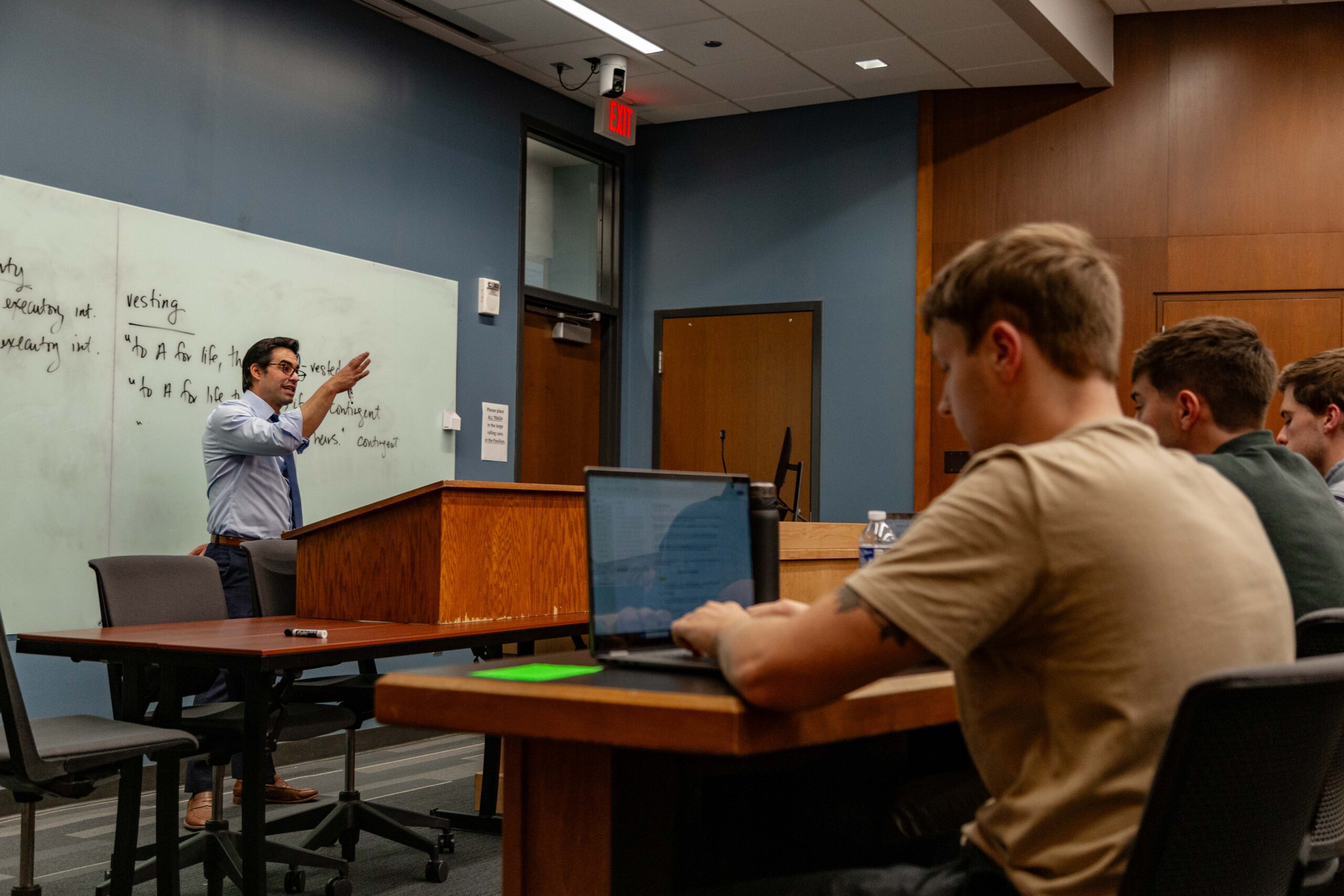
Sherkow delivers lecture at Chicago-Kent

Professor Jacob Sherkow delivered his lecture, “What’s the Skinny? Drug Labels and Patent Infringement,” at Chicago-Kent College of Law on Tuesday, October 28. The event focused on the role of drug labeling in pharmaceutical patent litigation and included discussion of the pending Supreme Court cert petition in Hikma v. Amarin, on which the Supreme Court has called for the views of the Solicitor General.

Sherkow cited extensively in blog post on drug labels

In an analysis of a brief expected to be filed in the fall, the Patently-O blog cites the work of Professor Jacob Sherkow extensively in examining the ‘label-plus’ theory of inducement. This framework establishes that a generic drug’s label by itself cannot violate patent protections because of a congressionally authorized regulatory scheme. Sherkow’s work, in particular, helps illuminate the distinction between regulatory and factual speech in the particulars of the case at issue.

Sherkow presents at ATRIP Congress in Copenhagen

In June, Professor Jacob Sherkow traveled to Denmark to present his work, “Patent Eligibility, Secure Computing, and Genomic Data Sharing,” at the ATRIP Congress at the University of Copenhagen. His presentation took place on Monday, June 23, as part of the Intellectual Property & Justice: Balancing Frameworks in Patent Law portion of the conference.

Sherkow quoted in article on polygenic testing startups

Polygenic testing startups offer consumers the chance of a “superbaby” by screening for genetic disorders and allowing parents to select certain embryos for fertilization; however, the ethics and the science of this practice are very controversial. Speaking to The San Francisco Standard, Professor Jacob Sherkow added his expertise on the issue. “[These companies] claim to have a proprietary algorithm, which, in reality, is a total black box,” he said. “If they are not completely accurate, consumers may make adverse health choices on the basis of misinformation.”

Sherkow presents research at Cambridge

Professor Jacob Sherkow recently had the chance to present his research, “A Sociotechnical Approach to Genomic Data Security: A Comparative Legal Analysis,” to the Law, Medicine and Life Sciences group at the University of Cambridge Faculty of Law. In addition to his position at the College of Law, where he serves as director of the Intellectual Property and Technology Law Program, Sherkow also holds appointments at the at the Carle Illinois College of Medicine, the European Union Center, and the Carl R. Woese Institute for Genomic Biology. He is a leading expert on IP protection for genome-editing technologies, such as CRISPR.

Multiple outlets quote Sherkow on CRISPR patent dispute

The US Court of Appeals for the Federal Circuit ruled in May that the key patents on what many consider the defining biotechnology invention of the 21st century should be reconsidered. Jennifer Doudna and Emmanuelle Charpentier shared a 2020 Nobel Prize for developing the versatile gene-editing system CRISPR; however, the key patent rights were granted Feng Zhang of the Broad Institute of MIT and Harvard in 2014. The rights have been contested since, and the appeals court ruling officially opens the question of ownership anew. Our intellectual property expert, Professor Jacob Sherkow, was quoted in multiple outlets about the dispute and what it means.

MIT Technology Review quotes Sherkow on restoring the woolly mammoth

Colossal Biosciences is making headlines with its bold initiative to bring back the woolly mammoth, but the venture raises significant ethical and legal questions. Professor Jacob Sherkow is quoted in a new article from the MIT Technology Review about the complexities surrounding intellectual property in de-extinction efforts. He notes that while natural animals cannot be patented, genetically modified organisms might be, leading to debates about ownership and commercialization of revived species.

Forthcoming paper by Sherkow focuses on drug labels

A drug label is a vital piece of information in patent cases, but a series of recent decisions from the U.S. Court of Appeals for the Federal Circuit have changed how the court assesses claims. In a forthcoming article in the Stanford Law Review, Professor Jacob Sherkow calls this new confusion over labels “infringement by label.” In the paper, Sherkow and his co-author examine unresolved questions in patent law and return pharmaceutical patent litigation to factual and doctrinal basis.

College of Law
504 East Pennsylvania Avenue
Champaign, IL 61820
(217) 333-0931