Illinois Law launches online Master of Science in Law and stackable graduate-level certificates for working professionals

The College of Law at the University of Illinois Urbana-Champaign now offers an online Master of Science in Law (MSL) and seven graduate-level certificates, with courses beginning in Spring 2027. Built for working professionals who need legal knowledge but do not intend to practice law, the new programs are flexible, accessible, affordable, and 100% online.

“Increasingly, professionals across a variety of sectors need legal fluency to be effective in their positions,” said Jamelle Sharpe, Dean of the College of Law. “Because the traditional legal education model was not designed to meet their needs, we wanted to create opportunities for upskilling that would help more people advance in their careers. These new programs have been developed with today’s working professional in mind. The topics are extremely timely, the pace is flexible, and the cost puts these programs well within reach of busy professionals looking for an excellent education at an affordable price.”

The online MSL builds applied legal knowledge in AI governance, cybersecurity, business law, corporate governance, and employment compliance, and can be completed in as little as 18 months. Students may pursue a concentration in Tech & Privacy or Business Compliance or choose from elective courses to complete the degree. No LSAT, GRE, or other graduate school exam is required for admission. The $90 MSL application fee is waived for applications received by December 15.

For learners who are not yet ready to commit to the full degree, the College also offers graduate-level certificates. Each certificate takes three courses and can stand alone or stack toward the online MSL, so students can earn valuable credentials that help them move ahead professionally even before they finish the degree. As with the MSL, no graduate school exam is required, and there is no fee to apply for a certificate. The seven certificates focus on high-demand professional skill areas:

  • Legal Foundations for Professionals
  • AI Privacy & Governance in Law
  • Cybersecurity Law & Resilience
  • Law of Emerging Technologies
  • Ethics & Corporate Governance
  • Advanced Business Law
  • Employment Law & Workplace Dynamics

“Legal knowledge shapes nearly every professional decision, but for most people it has stayed locked inside a three-year degree built for future lawyers,” said Rob Kar, Associate Dean for Curricular Innovation and Director of the Online MSL Program. “We built these programs from the ground up for non-lawyers, with all of the excellence and rigor of an Illinois Law program. Our students learn to spot legal risks earlier, communicate more effectively with legal counsel, and integrate legal advice into broader strategic decisions in ways that add value to their organizations and make them more confident professionals and leaders.”

Individual online courses can also be taken for credit as a non-degree student. Those credits may later be applied toward a certificate or the online MSL. In addition, Illinois students, faculty, and staff have free access on Coursera to sample videos and knowledge checks from select MSL courses. These open courses are a good way to build basic legal knowledge and explore a subject before committing to a certificate or degree. For more information and to apply, visit online.law.illinois.edu.

Kar publishes article on living contracts

Professor Robin Kar recently published a co-authored article in CHI, the #1 journal for Human-Computer Interaction. The article, “Living Contracts: Beyond Document-Centric Interaction with Legal Agreements,” explores a future where contracts educate users on legal rights not in the contract, transform legal language to help understanding, and proactively supply contractual information as needed; the authors refer to these interfaces as living contracts.

Lawless and Kar honored with 2026 College of Law awards for scholarly excellence

Professor Robert Lawless was awarded the 2026 Wayne R. LaFave Award for Scholarly Excellence for his book “Debt’s Grip: Risk and Consumer Bankruptcy” (University of California Press, 2025), co-authored with Deborah Thorne and Pamela Foohey. This award was established in 2002 by Michael Moore, the Charles R. Walgreen, Jr. Chair, and Heidi Hurd, the Ross and Helen Workman Chair in Law. The award was established in honor of Professor Wayne LaFave, whose remarkable scholarly legacy in criminal law and procedure is best honored through the recognition of work that is of matching ambition and importance.

Professor Robin Kar was awarded the 2026 Carroll P. Hurd Award for Scholarly Excellence for his article “The Contractual Death and Rebirth of Privacy,” 38 Harvard Journal of Law & Technology 1103 (2025), co-authored with Xiaowei Yu. The Carroll P. Hurd Award for Scholarly Excellence was established in 2002, also by Michael Moore and Heidi Hurd, in honor of Carroll Parsons Hurd, whose work as a political theorist and lawyer elevated theoretical curiosity and intellectual rigor above all other virtues.

Kar honored with 2026 Campus Award for Excellence in Faculty Leadership

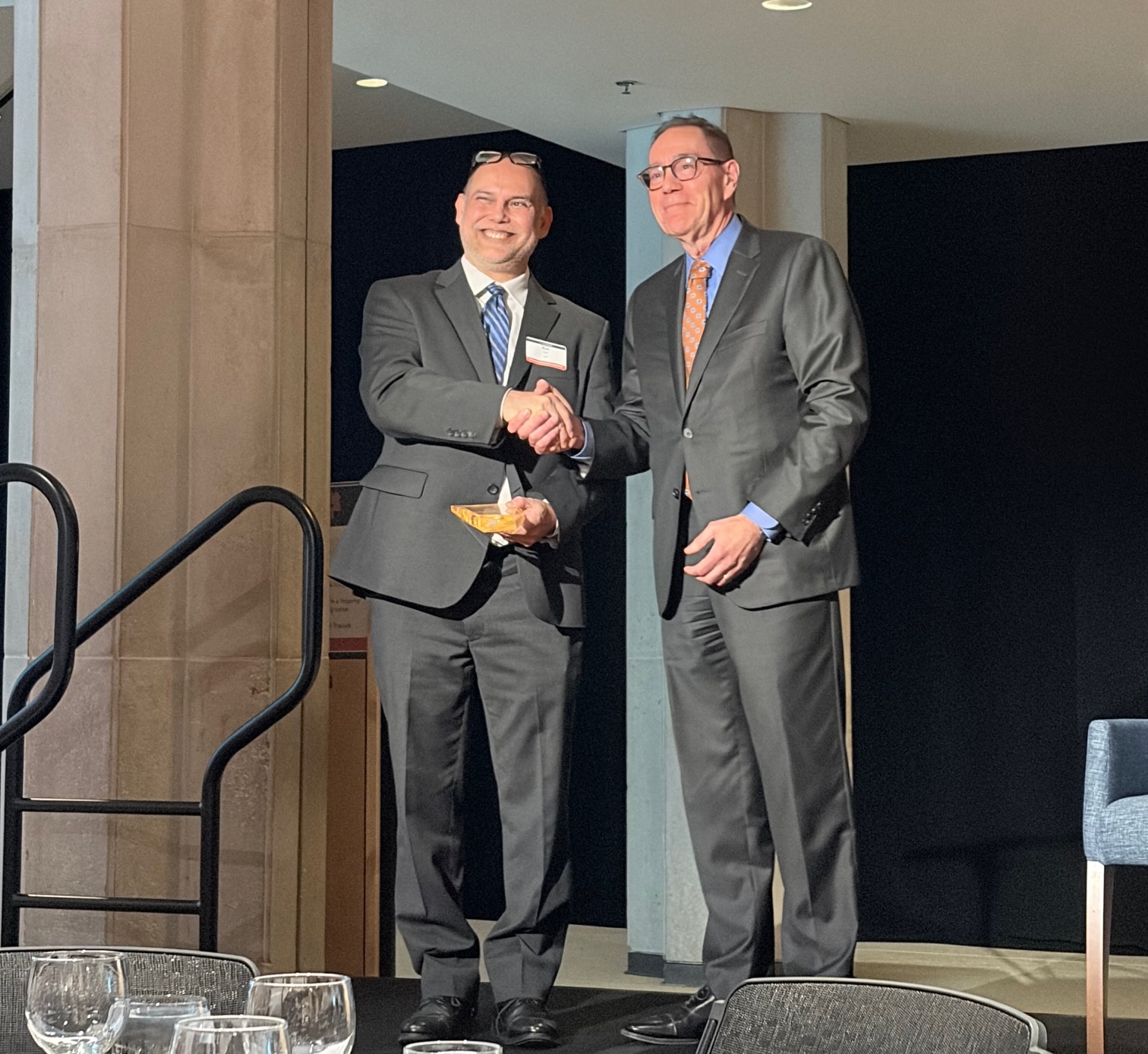
The University of Illinois Urbana-Champaign presents the Campus Awards for Excellence in Faculty Leadership each year to distinguished faculty who enrich the intellectual vitality of the university and the broader community. The awards were presented in three categories — faculty mentoring, distinguished executive officer and outstanding faculty leadership — to five faculty members during a ceremony hosted by the Office of the Provost on campus in March.

Robin Kar, a professor of law and philosophy and associate dean for curricular innovation at the College of Law, received the Outstanding Faculty Leadership Award. This award recognizes faculty members who have provided extraordinary leadership contributions across many dimensions of shared governance that advance the excellence of a unit, a college and/or the campus, and who exemplify the campus commitment to collaborative decision-making. The award is the highest accolade honoring a faculty member whose professional service has advanced progress toward the Illinois mission.

Kar has garnered several key leadership roles for the Urbana campus and the University of Illinois System, acting as a compass for the development and adoption of meaningful shared governance. These roles include serving as interim head of the Department of Philosophy for three years, chair of the Senate Executive Committee for three years, chair and vice chair of the of the University Senate for two years and chair of the Committee on Faculty Sexual Misconduct for one year. Kar established a style of leadership in the Department of Philosophy grounded in impartiality and open communication. He was credited with hiring and retaining philosophy professors that restored the department into a top 50 program globally and elevated it into the intellectually vibrant community that it is today. Kar was also cited for his initial work in 2018 in updating systemwide policies regarding sexual harassment, sexual assault and other forms of sexual misconduct and remains a trusted voice as those matters are continuously monitored. His approach to leadership — amid navigating complex problems — rests on listening to different and sometimes opposing perspectives and then “working creatively to harmonize them.” Kar’s record of shared governance is now being applied to his current leadership role as the inaugural associate dean for curricular innovation in the College of Law.

Kar publishes new article in Harvard Journal of Law & Technology

Professor Rob Kar has published “The Contractual Death and Rebirth of Privacy” in the Harvard Journal of Law & Technology. Co-authored with Xiaowei Yu, the abstract follows:

This Article proposes, for the first time, the application of “shared meaning analysis” — a method of contract interpretation grounded in traditional contract principles, as developed in Pseudo-Contract and Shared Meaning Analysis, 132 HARV. L. REV. 1135 (2019) (“PseudoContract”) — to online privacy policies. The method identifies when policy text adds enforceable terms to a contract, as opposed to mere unenforceable boilerplate, addressing an underappreciated paradigm slip in contract law that is enabling widespread digital surveillance. Consumers routinely click “I agree” to online privacy policies — which purport to permit cookies, other tracking devices (like pixels and SDKs), and AI-driven data analysis — without reading or comprehending their text, leading to massive transfers of personal information that erode privacy, facilitate consumer and political manipulation, and threaten freedom and democracy. Critiquing the binary debate over whether online privacy policies are contracts at all, this Article argues for a more nuanced reform: courts, operating within their common law authority, should revive privacy by focusing contract interpretation on the shared meanings of any contracts over privacy formed in digital contexts. Through examples involving policy scope, unilateral modifications, and conflicts between shared meaning and deceptive boilerplate, this Article demonstrates how contract interpretation — once returned to its rightful focus on shared meaning — can be used to counter modern surveillance harms without requiring new legislation, complementing other privacy frameworks and restoring the proper moral relationship between contract and privacy.

College of Law
504 East Pennsylvania Avenue
Champaign, IL 61820
(217) 333-0931