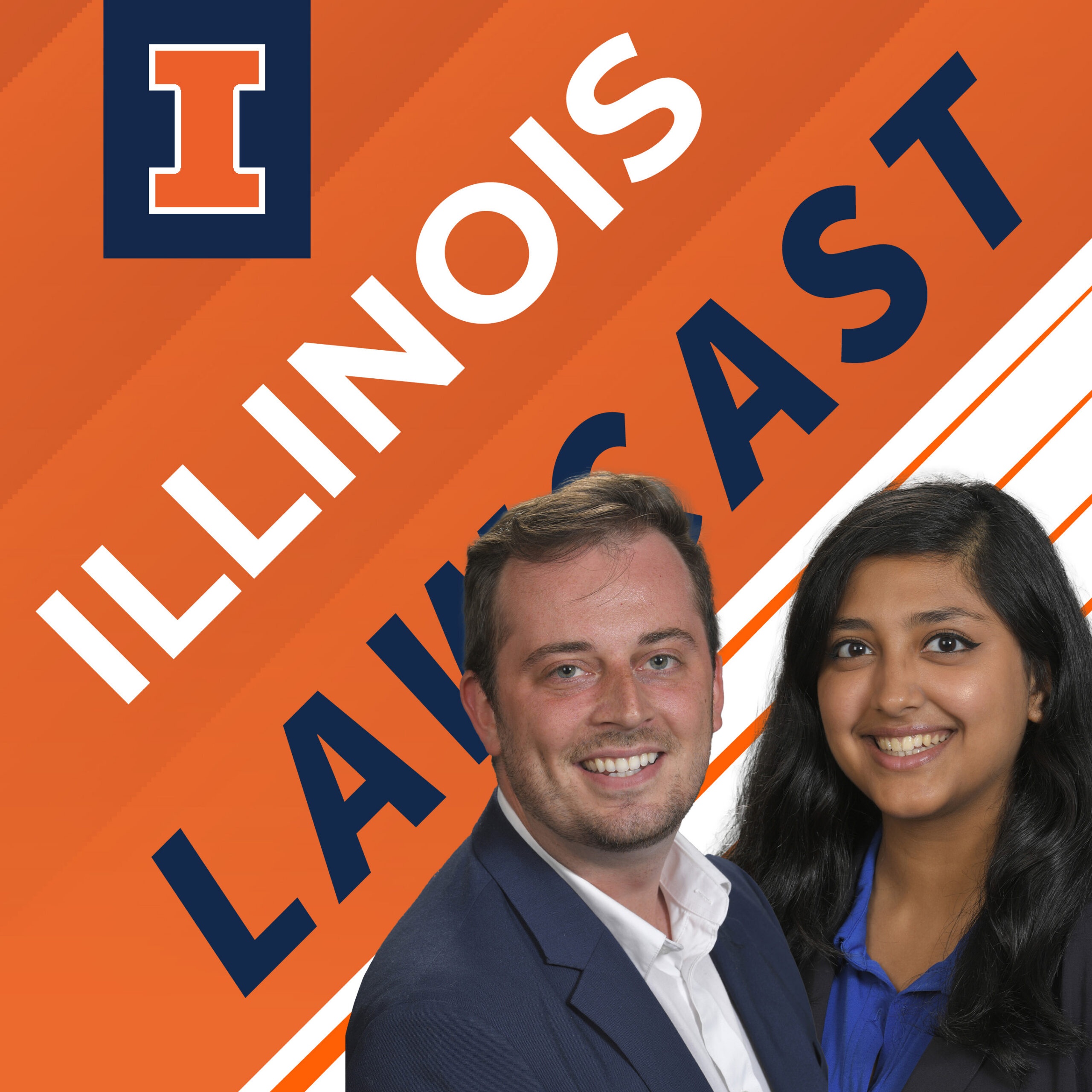
Illinois LawCast: All about NomosLearning

Bobby Mannis and Vindy Murthy, 2025 graduates, join the podcast to discuss their artificial intelligence-powered learning tool, NomosLearning. They share some background on how their education at Illinois inspired the building of this tool and how they came together to create a tool that all Illinois students can use. NomosLearning harnesses the power of AI to supplement reading for students, creating issue spotters and case briefs to guide their studies. The co-founders also share some of their vision for the future of NomosLearning and their careers.

To learn more, visit https://www.nomoslearning.com/.

Disclaimer: this podcast is for informational purposes only and does not constitute an endorsement or approval by the College of Law. Please contact Nomos Learning for answers to questions regarding its content.

If you have comments or suggestions for the podcast, please contact podcast@law.illinois.edu.

Journal of Empirical Legal Studies selects article by Robbennolt and Winship for publication

The Journal of Empirical Legal Studies has selected “Settlementality,” an article co-authored by Professors Jennifer Robbennolt, Verity Winship, and alumna Jessica Bregant, for publication. Slated to be published later this year, the article is meanwhile available at https://papers.ssrn.com/sol3/papers.cfm?abstract_id=4773926.

According to the authors, “Settlementality” breaks new ground by exploring how everyday people perceive the role of settlements in the legal system. Their novel empirical study provides the first systematic investigation into lay opinions of settlement. They surveyed a nationally representative sample of more than 1,000 U.S. adults to ask them what they think about settlement. Respondents told them, for example, the extent they agreed or disagreed with statements like these: “A settlement between two parties is nobody’s business but their own.” “Settling parties are more interested in money than justice.” “Settlementality” promises to be a foundational article in an emerging body of empirical scholarship about settlement, reporting for the first-time what respondents thought settlement should look like.

The Journal of Empirical Legal Studies is a peer-edited, peer-refereed, interdisciplinary journal that publishes high-quality, empirically-oriented articles of interest to scholars in a diverse range of law and law-related fields, including civil justice, corporate law, criminal justice, domestic relations, economic, finance, health care, political science, psychology, public policy, securities regulation, and sociology. 

McClane article selected as one of the Top 10 Corporate and Securities Articles of 2024

Professor Jeremy McClane’s article, “The Lost Promise of Private Ordering,” 109 Cornell L. Rev. 1-62 (2023), has been selected as one of the Top 10 Corporate and Securities
Articles of 2024 by the Corporate Practice Commentator. Academic teachers in the areas of corporate and securities law selected the winning articles from a list of over 300 articles published in legal journals in 2024. The full list of 2024 winners will be published in the upcoming issue of the Corporate Practice Commentator.

Changes to CFPB will affect the average person, Lawless tells News Bureau

“It’ll just be a steady drip, drip, drip of companies trying to game the system and nickel and dime people via aggressive practices,” Professor Robert Lawless told the Illinois News Bureau about changes to the Consumer Financial Protection Bureau. He noted that laws preventing actions like those taken by banks preceding the subprime mortgage crisis will still be in effect, but other protections are very much at risk. “Over the long run, it’s going to affect people. It’ll be the frog and the boiling pot of water. It’ll be a steady ratcheting up of unfair practices, and there will be no more cops left to police the beat,” he added.

Lawless discusses dismissal of bankruptcy watchdog

Tara Twomey’s tenure as executive director of the U.S. Trustee Program was recently terminated by the Trump administration, drawing criticism from Professor Robert Lawless. In a blog for Credit Slips, Lawless writes that “Under Twomey’s leadership the US Trustee Program did dozens of things that make the system work just a little bit better for the people who need it,” and Bloomberg quoted him as saying the move was “a short-sighted and likely illegal decision.” In a follow-up blog, Lawless also responded to criticism of Twomey and defended her qualifications to work at the Department of Justice.

Read Lawless’s original blog post and follow-up post.

American College of Bankruptcy names Joshua Livingston ’25 a Distinguished Bankruptcy Student

The American College of Bankruptcy has selected Joshua Livingston ’25 as the Seventh Circuit Distinguished Bankruptcy Law Student for 2025. Distinguished Bankruptcy Law Students are selected annually for each Circuit based on their academic excellence, professional accomplishments in bankruptcy or restructuring-related courses, passion for restructuring and insolvency, and commitment to public service and pro bono efforts.

Livingston was nominated for the award by Professors Ralph Brubaker and Robert Lawless, internationally renowned scholars in the field of bankruptcy. In their letter recommending Livingston, the professors were effusive in their praise for him, highlighting the way his enthusiasm for bankruptcy matches their own. Specifically, Brubaker and Lawless noted he is “someone who obviously appreciates all of the nuance and complexity of bankruptcy law and practice, asking very thoughtful and sophisticated questions.”

Bankruptcy is a topic that Livingston learned about early in life, having personally witnessed the process through the failure of his father’s business when he was just 10 years old. The fresh start his father was afforded via bankruptcy allowed him to find a new career, which he has successfully practiced for 35 years; bankruptcy as a “catalyst for positive life changes,” as Livingston explained, helped fuel his eagerness to work in the field. He also cited his experience in the College of Law’s bankruptcy courses as a spark for the “intellectual passion for the subject that has shaped my academic career.”

Last summer, Livingston completed an internship with the U.S. Trustee’s office in Chicago and is planning on a career in bankruptcy law. He is seeking a clerkship position with a bankruptcy judge after graduation and ultimately wants to work in a business bankruptcy practice. “He is immensely practical and has a broad and sophisticated skill set that equips him to be a fantastically successful bankruptcy attorney (which we fully expect him to be),” Brubaker and Lawless wrote in their letter recommending him.

As recipient of the Distinguished Bankruptcy Law Student award, Livingston will be honored at a special reception on Thursday, March 20, in Washington D.C. In addition, the American College of Bankruptcy will provide him an all-expense paid trip to attend the College Induction Ceremony and Annual Meeting.

CBS quotes Lawless on when to file bankruptcy

When struggling with debt, many people delay filing for bankruptcy as long as possible; however, delaying may be more harmful than many realize. “People misunderstand bankruptcy and wait too long to see a bankruptcy lawyer. Most people would benefit by going earlier,” Professor Robert Lawless told CBS in a new article about the timing of personal bankruptcy filings. Lawless also shares tips for those who may need to file and his opinion on how the system could be improved.

Lawless publishes new article on overindebtedness

Research on overindebtedness and household incomes represents “low-hanging fruit,” according to Professor Robert Lawless. In a new article published in the Annual Review of Law and Social Science, he and his co-authors review current literature about who files bankruptcy, what causes bankruptcy, what happens in bankruptcy court, and what happens after cases conclude. They also propose a research agenda that will contribute to broader sociological and sociolegal research agendas in various fields.

Kaplan recognized with Lifetime Achievement Award

Professor Richard Kaplan is the recipient of the 2025 AALS Aging and Law Section’s Lifetime Achievement Award. The award honors his distinguished career of teaching, service, and scholarship in aging and the law. A letter from the AALS Aging and Law Section explained his selection, noting “dedicated service to the profession, to your students, to colleagues in mentorship, and to advancing scholarship in the field with your valuable contributions.”

Professor Kaplan has been teaching since 1979, has seven published books, and over 80 publications. He also has dedicated his career to enabling others to succeed. Under his leadership, the Elder Law Journal has created a forum for scholars from around the world to publish quality articles related to elder law, while simultaneously encouraging new generations of lawyers and law students to pursue work in this area.

Kaplan will be recognized at the Section on Scholarship’s Award Ceremony on Friday, January 10, 2025. 

Kaplan presents at the American Tax Policy Institute Symposium

Professor Richard Kaplan presented “Gender Discrimination in Retirement Plan Distributions” at the American Tax Policy Institute Symposium, It’s a Man’s World: Revealing and Addressing Hidden Gender Bias in Tax Law and Policy, in Washington, D.C. His paper will appear next year in an issue of the Pittsburgh Tax Review devoted to the Symposium’s presentations.

College of Law
504 East Pennsylvania Avenue
Champaign, IL 61820
(217) 333-0931