Veterans Legal Clinic students help win discharge upgrade

Maybe you’ve heard this one before: an employee fails a urine test despite never having used drugs, only to discover the culprit was a poppyseed muffin. As this story unfolded over a half-hour episode of Seinfeld, the comedy of errors was easy to laugh at, but when a similar case was brought to the Veterans Legal Clinic it was no laughing matter.

As a result of his failed urinalysis, the veteran received a general rather than an honorable discharge and came to the Clinic seeking a discharge upgrade. Discharges that are not honorable can have many effects on veterans, including preventing them from accessing some veteran resources and making future employment more difficult to obtain; in addition, having an honorable discharge can be a matter of pride for veterans, recognizing their service to country. Students in the Clinic eagerly took on the case, excited by the chance to help and to tackle an interesting challenge.

Several groups of students worked on this case for the Veterans Legal Clinic, including Wyatt Decker ‘24, Briley McVey ’24, Matthew Schwartz ’24, and Ian Waggoner ‘24. According to Clinic Director Yulanda Curtis, students logged more than 115 hours working on the case and it took more than a year to hear back from the government after filing a brief. In the end, however, the clinicians prevailed and earned their client a discharge upgrade.

“There aren’t many lawyers who assist veterans with discharge upgrades…. The most recent data I have shows only about a third of veterans successfully secure a character of discharge upgrade from our client’s branch of service, so when we win these cases it feels like we took on Goliath and won,” Curtis said. “Additionally, our client just wanted someone to believe him and I think we were the first people to take him seriously.”

Immediately after his urine test came back positive, the veteran submitted hair follicles to reputable labs for secondary testing and both labs reported negative results for all drugs. However, when the veteran presented those tests to his commanding officer, they were not considered. Clinic students, however, did not dismiss the veteran’s claims of innocence and worked diligently to support him.

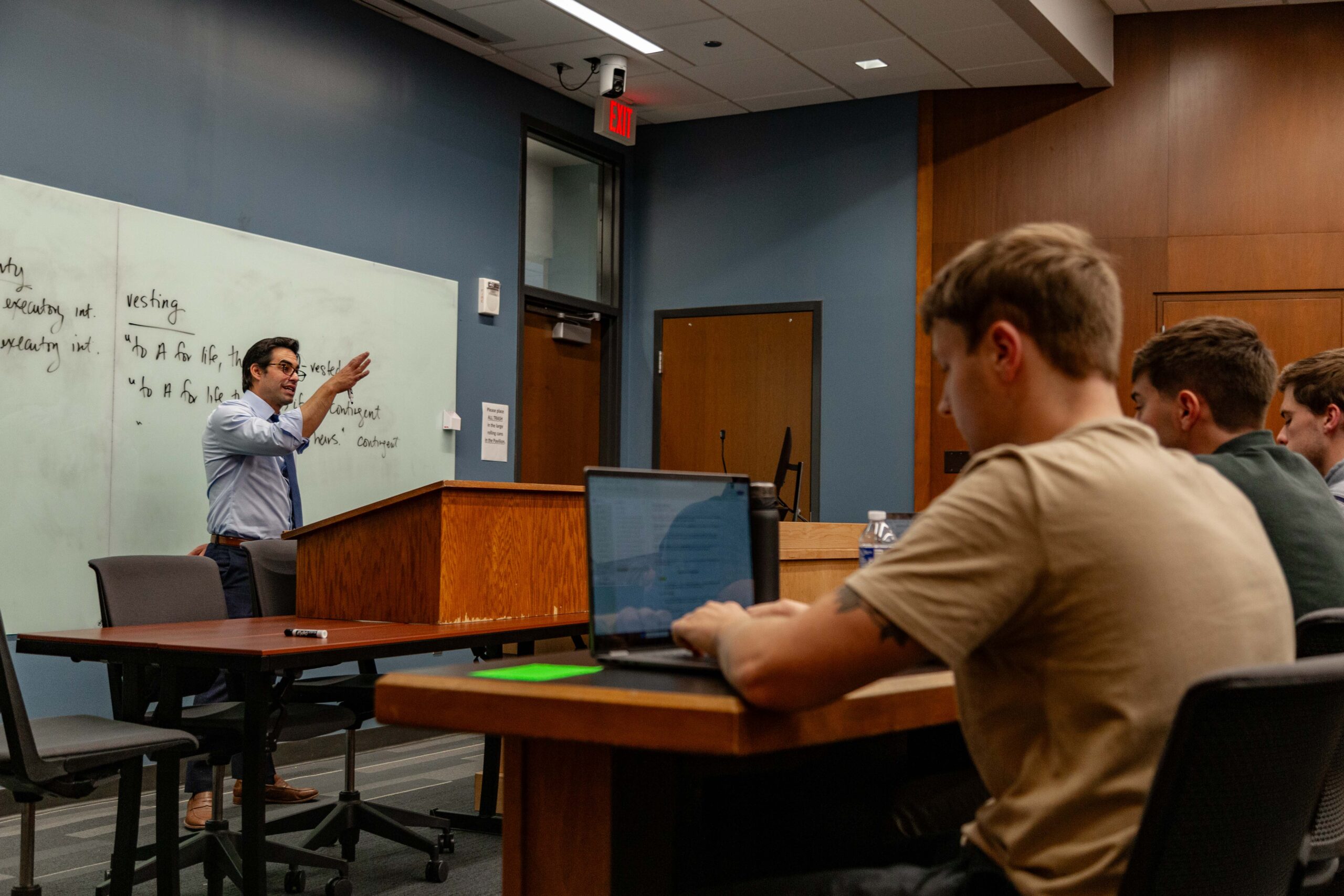
“A lot of the routine cases you get can be pretty formulaic…not that every case is the same, but you’ve got the same sort of motions that you’re drafting or submitting to the court arguing the same sort of preliminary hearings. But this one was a lot, you had to delve into the science of it,” Waggoner said.

In addition to skillful fact investigation that uncovered character references and grocery receipts for the offending muffins, students collaborated with professionals across campus. Research librarians helped find materials supporting the validity of hair follicle tests over urinalysis, which proved an important aspect of the case. This research, combined with a memorandum from the Department of Defense, issued shortly after their client was discharged, warning servicemembers to avoid consuming poppy seeds, created a strong case that overcame the odds against obtaining a discharge upgrade.

Because of the delays in the case, however, the students who had put in so much hard work ended their semester in the clinic and graduated without a resolution in the case.

“Having to just walk away was definitely a little frustrating, especially because he was a very involved client in the best way possible. He was easy to reach, and he trusted us,” Schwartz said.

Though their professional careers have taken them in different directions and areas of the law that may not require them to think about urinalysis, Schwartz and Waggoner felt “ecstatic” to receive news of their client’s success in upgrading his discharge early in 2025. The positive outcome also reinforced their belief in the value of clinics.

“Law school helps teach a lot and train you, but it doesn’t always feel as practical,” Schwartz said.

“You talk about the black letter law, but you will never get a class that teaches you how to respond to a client,” Waggoner added. “It’s invaluable. I think everyone should be required to do a clinic or some sort of like, practical class.”
Wexler invited to affiliate with National Institute of Military Justice as a Fellow

In recognition of her excellence and distinction as a leader in the field of military law, Professor Lesley Wexler has been invited to affiliate with the National Institute of Military Justice (NIMJ) as a Fellow. NIMJ was founded in 1991, and is the only American non-profit institute dedicated to the study of improvement of the military justice system. Wexler joins fellow College of Law professor and military veteran Tony Ghiotto in her affiliation with NIMJ.

Hurd delivers Alistair Macleod Distinguished Lecture in Philosophy at Queen’s University

Heidi M. Hurd gave the prestigious Alistair Macleod Distinguished Lecture in Philosophy at Queen’s University in Kingston, Ontario, in late February 2025. Entitled “The Immorality of Mercy,” Professor Hurd’s talk to a packed auditorium of faculty and graduate students in law and the humanities challenged the claim that mercy is compatible with justice. 

Gerke publishes co-authored article in New England Journal of Medicine

If 23andMe goes bankrupt, what happens to their millions of customers’ personal and genetic data?

Sara Gerke, Melissa B. Jacoby, and I. Glenn Cohen explore this issue in a new article published on March 2 in the New England Journal of Medicine, titled “Bankruptcy, Genetic Information, and Privacy — Selling Personal Information.”

The data are not protected by HIPAA, the authors note. The U.S. has no comprehensive federal privacy laws (and handful of overlapping, conflicting state laws.) Sure, Congress could pass consumer protection laws, but “it has been difficult to get large-scale privacy reform through Congress.”

Indeed, as the authors note, 23andMe’s privacy statement “reserves the company’s right to transfer customers’ personal information in the event of a company sale or bankruptcy.”

Basically, Gerke, Jacoby, and Cohen argue, little is stopping this data (potentially 14 million consumers’ worth) from being sold to the highest bidder.

Conclusion: “We believe it’s time to reconsider how [genetic information] data are regulated.”

Sara Gerke is an associate professor at the University of Illinois Urbana-Champaign College of Law. Melissa B. Jacoby is a law professor at the University of North Carolina at Chapel Hill. I. Glenn Cohen is a Harvard Law professor and faculty director of the Petrie-Flom Center for health law policy, biotechnology, and bioethics at Harvard Law School.

J. Sharpe and Rowell quoted in article on threats to DEI programs

The “Dear Colleague Letter” issued by the U.S. Department of Education in February expressed a threat that schools that support diversity initiatives could face funding cuts. With several cultural houses on campus, University of Illinois Urbana-Champaign could be among the targets to lose funding. In an extensive examination, Illinois Public Media quotes both Dean Jamelle Sharpe and Professor Arden Rowell on how the letter may affect the Illinois campus and the levels of uncertainty that exist currently. “The Department is taking a very aggressive and expansive view of the Supreme Court’s decision,” Sharpe said. “They believe it should be applied to situations that the Supreme Court’s decision itself did not address.”

Forthcoming paper by Sherkow focuses on drug labels

A drug label is a vital piece of information in patent cases, but a series of recent decisions from the U.S. Court of Appeals for the Federal Circuit have changed how the court assesses claims. In a forthcoming article in the Stanford Law Review, Professor Jacob Sherkow calls this new confusion over labels “infringement by label.” In the paper, Sherkow and his co-author examine unresolved questions in patent law and return pharmaceutical patent litigation to factual and doctrinal basis.

Illinois LawCast: Teaching Black History with Juan Thomas

Juan Thomas has found great success in the legal world and in politics since graduating from Illinois Law in 1996, and now he is taking the time to give back by teaching The History of the African-American Lawyer in the United States. We talked about his path to the law and why he is passionate about sharing Black history with a new generation of students.

If you have comments or suggestions for the podcast, please contact podcast@illinois.edu.

American College of Bankruptcy names Joshua Livingston ’25 a Distinguished Bankruptcy Student

The American College of Bankruptcy has selected Joshua Livingston ’25 as the Seventh Circuit Distinguished Bankruptcy Law Student for 2025. Distinguished Bankruptcy Law Students are selected annually for each Circuit based on their academic excellence, professional accomplishments in bankruptcy or restructuring-related courses, passion for restructuring and insolvency, and commitment to public service and pro bono efforts.

Livingston was nominated for the award by Professors Ralph Brubaker and Robert Lawless, internationally renowned scholars in the field of bankruptcy. In their letter recommending Livingston, the professors were effusive in their praise for him, highlighting the way his enthusiasm for bankruptcy matches their own. Specifically, Brubaker and Lawless noted he is “someone who obviously appreciates all of the nuance and complexity of bankruptcy law and practice, asking very thoughtful and sophisticated questions.”

Bankruptcy is a topic that Livingston learned about early in life, having personally witnessed the process through the failure of his father’s business when he was just 10 years old. The fresh start his father was afforded via bankruptcy allowed him to find a new career, which he has successfully practiced for 35 years; bankruptcy as a “catalyst for positive life changes,” as Livingston explained, helped fuel his eagerness to work in the field. He also cited his experience in the College of Law’s bankruptcy courses as a spark for the “intellectual passion for the subject that has shaped my academic career.”

Last summer, Livingston completed an internship with the U.S. Trustee’s office in Chicago and is planning on a career in bankruptcy law. He is seeking a clerkship position with a bankruptcy judge after graduation and ultimately wants to work in a business bankruptcy practice. “He is immensely practical and has a broad and sophisticated skill set that equips him to be a fantastically successful bankruptcy attorney (which we fully expect him to be),” Brubaker and Lawless wrote in their letter recommending him.

As recipient of the Distinguished Bankruptcy Law Student award, Livingston will be honored at a special reception on Thursday, March 20, in Washington D.C. In addition, the American College of Bankruptcy will provide him an all-expense paid trip to attend the College Induction Ceremony and Annual Meeting.

Murphy publishes co-edited volume on Technology and Equality

What role does technology have in global inequalities and can new technologies be instrumental in making the world less unfair? In the new volume Technology and Equality, co-edited by Professor Colleen Murphy, these issues and others are addressed from a wide range of perspectives by scholars from multiple disciplines. The book is published by Rowman & Littlefield Publishers and available now.

Learn more about Technology and Equality.

College of Law
504 East Pennsylvania Avenue
Champaign, IL 61820
(217) 333-0931