College of Law establishes Jurist in Residence program and welcomes inaugural guest Judge Thomas Kirsch

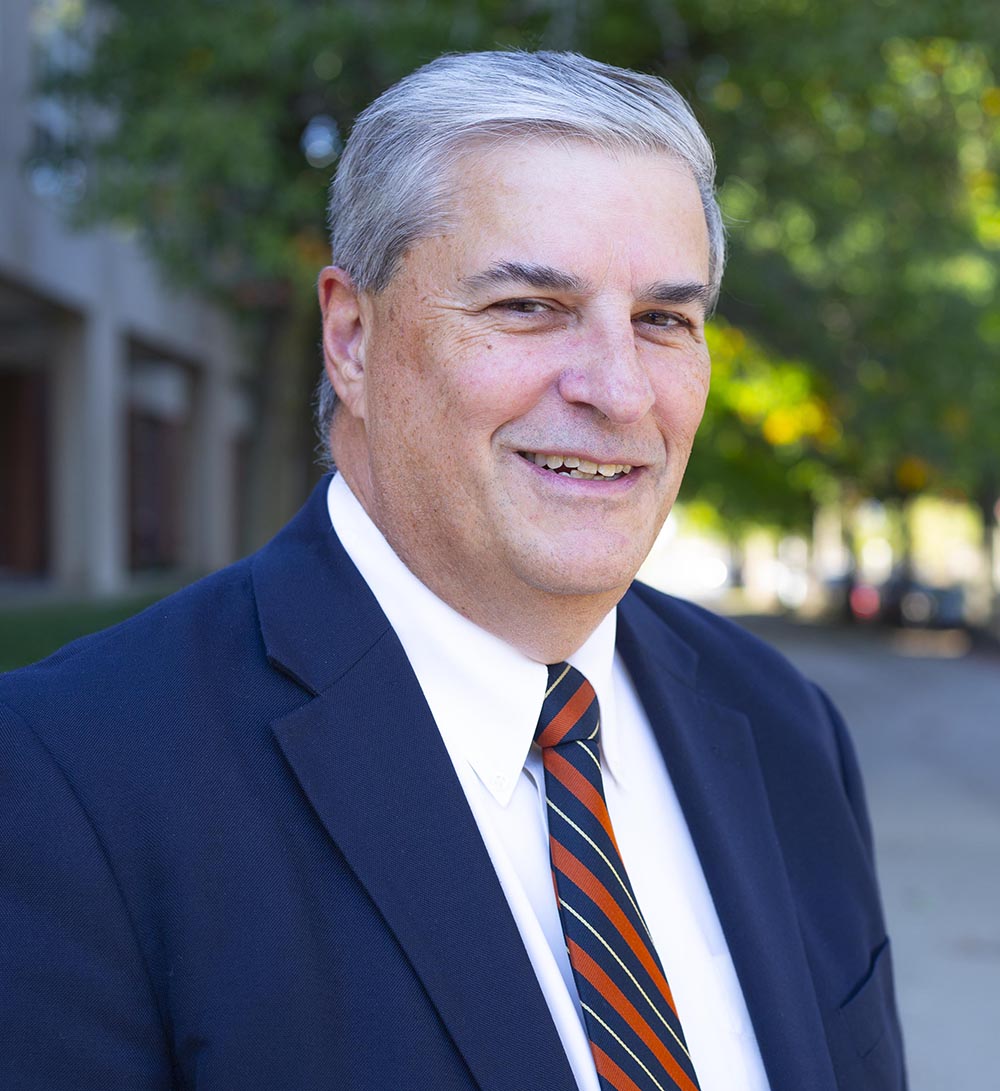
Judge Thomas Kirsch of the United States Court of Appeals for the Seventh Circuit recently completed a multi-day visit at the College of Law, as the inaugural Jurist in Residence. The newly launched program aims to deepen the College’s connections to the bench, inspire students to pursue judicial clerkships, and provide them with the opportunity to learn from leading legal minds. Although Jurist in Residence programs are not uncommon at law schools around the country, the University of Illinois College of Law is one of only two law schools in the state to formalize the initiative. Moving forward, the College intends to host a Jurist in Residence on an annual basis. 

Executive Assistant Dean for Career Planning and Professional Development Greg Miarecki, who was instrumental in the creation and launch of the program, said “Our state and federal judges are on the cutting edge of legal issues and developments. Through the Jurist in Residence program and other College of Law initiatives, we are excited to partner with them to prepare the next generation of leading legal minds.” 

During his time at the College, Judge Kirsch taught a seminar-style short course on public corruption and participated in several student-focused events. Over 90 students attended a Fireside Chat with Judge Kirsch, co-sponsored by the Anderson Center for Advocacy and Professionalism and moderated by the Center’s Director, Professor Tony Ghiotto, along with Dean Miarecki.

3L Bobby Mannis was grateful for the opportunity to take Judge Kirsch’s course.

“Judge Kirsch sharing his perspective as a Seventh Circuit jurist and former U.S. Attorney deepened my desire to pursue white-collar prosecution,” he said. “This class, where Judge Kirsch knew each of our names, taught about statutes and their interpretation, and shared his experiences, is a defining moment in my law school career.”

Student organizations were also eager to make connections with Judge Kirsch, and a Federalist Society-sponsored talk on how to have a meaningful career in public service gave them the opportunity to do just that.

Sophia Downes, 2L and president of the student chapter of the Federalist Society, helped coordinate that event.

“Judge Kirsch shared his experience working at the Department of Justice as the United States Attorney and on the bench, providing valuable advice to students interested in becoming federal prosecutors and judges. He also discussed his transition from the private to public sector and qualities judges and government employers look for when hiring candidates.”

The visit also featured a luncheon for College of Law faculty and local judges from the state and federal benches. Judge Kirsch and Andy Leipold, a professor of law at the College and a leading criminal law scholar, led a wide-ranging discussion.

Dean Jamelle Sharpe said, “Providing opportunities for our students to learn directly from judges is imperative for them to better understand the judicial system. It also encourages them to consider careers in the judiciary. I am grateful to Judge Kirsch for so generously giving of his time to make our inaugural session of the program a success. I look forward to hosting him at the College again in the near future, and to hosting other jurists for many years to come.”


Thomas L. Kirsch II is a Circuit Judge of the United States Court of Appeals for the Seventh Circuit. Prior to his judicial appointment in 2020, he served as the United States Attorney for the Northern District of Indiana since 2017. From 2008 until 2017, Judge Kirsch was a partner at Winston & Strawn LLP in Chicago, litigating commercial and criminal matters in trial and appellate courts across the United States and conducting corporate internal investigations. Before joining Winston & Strawn, Judge Kirsch served as an Assistant United States Attorney in the Northern District of Indiana from 2001 to 2008, focusing on white collar investigations and prosecutions, including the prosecution of numerous elected and appointed public officials. In 2006 and 2007, Judge Kirsch served as Counsel to the Assistant Attorney General at the United States Department of Justice Office of Legal Policy in Washington, D.C. He is a former law clerk to the Honorable John D. Tinder in the Southern District of Indiana. Judge Kirsch is a Fellow of the American College of Trial Lawyers.

Judge Thomas Kirsch teaches a class at the College of Law

Francis Boyle, long-time College of Law faculty member, passes away

Professor Francis Boyle passed away on Thursday, January 30, 2025. Professor Boyle, an internationally recognized scholar of human rights and international law, was a member of the College of Law faculty for 47 years and touched the lives of generations of students, not to mention his colleagues.

Over his career, Professor Boyle represented national and international bodies including the Blackfoot Nation (Canada), the Nation of Hawaii, and the Lakota Nation, as well as numerous individual death penalty and human rights cases. He advised numerous international bodies in the areas of human rights, war crimes and genocide, nuclear policy, and bio-warfare. He served as counsel to Bosnia and Herzegovina and to the Provisional Government of the Palestinian Authority. He also represented two associations of citizens within Bosnia and was involved in developing the indictment against Slobodan Milosević for genocide, crimes against humanity, and war crimes in Bosnia and Herzegovina. From 1991-92, he served as Legal Advisor to the Palestinian Delegation to the Middle East Peace Negotiations.

Professor Boyle served on the Board of Directors of Amnesty International, as a consultant to the American Friends Service Committee, and on the Advisory Board for the Council for Responsible Genetics. He was involved in drafting the U.S. domestic implementing legislation for the Biological Weapons Convention, known as the Biological Weapons Anti-Terrorism Act of 1989, that was approved unanimously by both Houses of the U.S. Congress and signed into law by President George H.W. Bush.

Professor Boyle received an AB (1971) in Political Science from the University of Chicago, then a JD degree magna cum laude from Harvard Law School, and AM and PhD degrees in Political Science from Harvard University. Prior to joining the academy, he practiced tax law with Bingham, Dana & Gould.

Professor Boyle is survived by his wife, Betsy, and their children.

Finkin honored for his contributions to the fields of labor law and higher education law

After a 36-year career at the University of Illinois College of Law, Swanlund Endowed Chair and Professor Matthew Finkin officially retired and was granted emeritus status in the fall of 2024. A prolific and highly respected labor law scholar, Finkin has been honored at several significant events in recent months. 

In June, a session on comparative labor law during the Annual Meeting of the Labor and Employment Relations Association celebrated Finkin’s career, books, and contributions to Comparative Labor Law and Policy Journal. Fellow scholars in the field called Finkin “the top comparative labor law scholar in the last 50 years,” and said, “Matt has done more than anyone to raise our eyes from the drama of the birth of labor relations in the U.S.”

Finkin’s retirement also motivated the organization of a high-profile event right here at the University of Illinois, in celebration of his contributions to the important topics of freedom of speech and academic freedom. The Campus Speech and Academic Freedom Roundtable took place on Friday, January 24, 2025, and featured world-renowned scholars and public intellectuals who engaged with the contentious questions raised by recent high-profile incidents of unpopular speech on American college campuses.  

The current Dean of the UC-Berkeley School of Law, Erwin Chemerinsky, and Finkin himself, addressed the ways in which the First Amendment and university commitments to academic freedom relate in cases involving controversial faculty speech. The past Dean and Sterling Professor of Law at Yale Law School, Robert Post, addressed the defensibility and wisdom of the now-common practice by universities, colleges, and departments to take public positions on matters of contemporary dispute. And Illinois’ Michael S. Moore, the Charles R. Walgreen Jr. University Chair, and Heidi M. Hurd, the past Dean and Ross and Helen Workman Chair in Law, teamed up to address the legitimate responses available to university administrators who are faced with blameworthy student speech. Attended by College of Law faculty, students, and alumni, the four lectures prompted lively conversations throughout the day and served as a fitting tribute to Professor Finkin.

Group photo of the reception honoring Matthew Finkin

Illinois LawCast: Understanding the TikTok ban with Lena Shapiro

The Supreme Court unanimously agreed the law banning TikTok from the United States was constitutional and should go into effect as written; however, on January 20th, President Donald Trump instructed the Attorney General not to enforce the law for 75 days. So, what is going on and what is the legal basis for any of it? Professor Lena Shapiro, who also leads our First Amendment Clinic Director, joined us for a bonus episode of the podcast to examine the details behind this case.

If you have comments or suggestions for the podcast, please contact podcast@law.illinois.edu.

Illinois LawCast: Navigating NIL with Kam Cox

In this episode, Assistant Director of Athletics, Strategic Initiatives Kamron Cox joins to talk about his journey through the law to the University of Illinois Athletics Department. When he was hired for his role with the Fighting Illini, Kam was the first specialist in name, image, and likeness law among Power 5 schools. He shared how he has traversed the changing landscape of college athletics to help the Illini find success on many different fields, and how he uses that knowledge in the classroom as an adjunct professor at the College of Law.

If you have comments or suggestions for the podcast, please contact podcast@law.illinois.edu.

Illinois LawCast: Get to know Bill Watson and Sara Gerke

In this episode, our newest faculty members, Bill Watson and Sara Gerke, sit down to discuss their path to Illinois Law, their specialties, and how they are enjoying their time at the College of Law thus far.

If you have comments or suggestions for the podcast, please contact podcast@law.illinois.edu.

Lawless publishes new article on overindebtedness

Research on overindebtedness and household incomes represents “low-hanging fruit,” according to Professor Robert Lawless. In a new article published in the Annual Review of Law and Social Science, he and his co-authors review current literature about who files bankruptcy, what causes bankruptcy, what happens in bankruptcy court, and what happens after cases conclude. They also propose a research agenda that will contribute to broader sociological and sociolegal research agendas in various fields.

Kaplan recognized with Lifetime Achievement Award

Professor Richard Kaplan is the recipient of the 2025 AALS Aging and Law Section’s Lifetime Achievement Award. The award honors his distinguished career of teaching, service, and scholarship in aging and the law. A letter from the AALS Aging and Law Section explained his selection, noting “dedicated service to the profession, to your students, to colleagues in mentorship, and to advancing scholarship in the field with your valuable contributions.”

Professor Kaplan has been teaching since 1979, has seven published books, and over 80 publications. He also has dedicated his career to enabling others to succeed. Under his leadership, the Elder Law Journal has created a forum for scholars from around the world to publish quality articles related to elder law, while simultaneously encouraging new generations of lawyers and law students to pursue work in this area.

Kaplan will be recognized at the Section on Scholarship’s Award Ceremony on Friday, January 10, 2025. 

SSRN features Q&A with Gerke

Professor Sara Gerke was recently featured on the SSRN blog, discussing her extensive research. As part of their “Meet the Author” series, Gerke participated in a question and answer session covering her research on the ethical and legal challenges of artificial intelligence and big data for health care and health law in the United States and Europe. She shared some of her background and much about her research in the interview.

Kaplan presents at the American Tax Policy Institute Symposium

Professor Richard Kaplan presented “Gender Discrimination in Retirement Plan Distributions” at the American Tax Policy Institute Symposium, It’s a Man’s World: Revealing and Addressing Hidden Gender Bias in Tax Law and Policy, in Washington, D.C. His paper will appear next year in an issue of the Pittsburgh Tax Review devoted to the Symposium’s presentations.

College of Law
504 East Pennsylvania Avenue
Champaign, IL 61820
(217) 333-0931