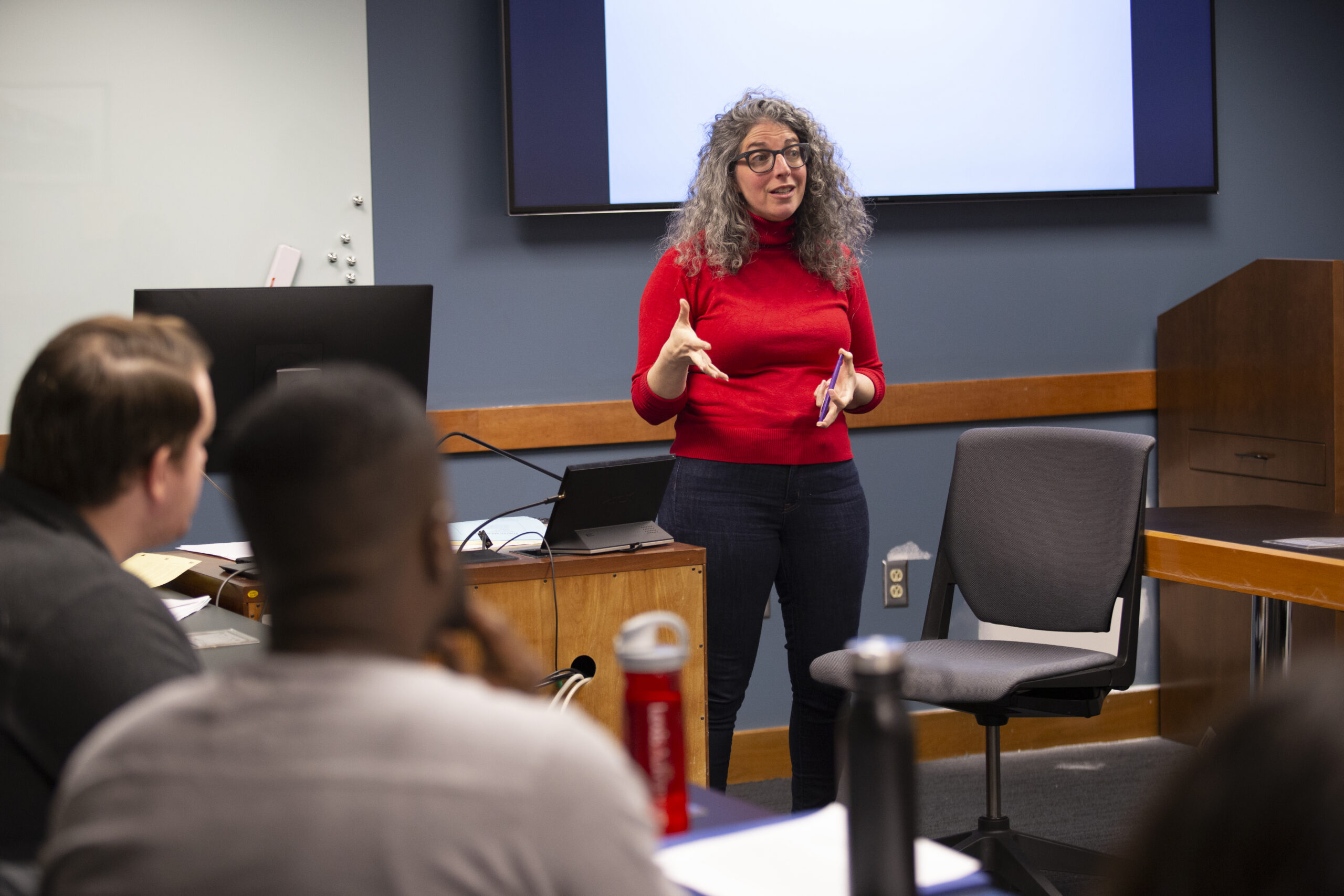
Aronson publishes op-ed in The Fulcrum

Writing from the perspective of an immigration lawyer who has represented hundreds of clients in asylum claims, professor and director of the Immigration Law Clinic Lauren Aronson recently published an op-ed in The Fulcrum. An excerpt follows:

“In my dual role as a clinical law professor at the University of Illinois College of Law, my students and I represent immigrants fighting against deportation. I believe so deeply in the U.S. Constitution’s mandate that all people are entitled to due process that I zealously advocate for those who cannot defend themselves and teach young lawyers to do the same.”
Wilson discusses conversion therapy case on Political as Heck Utah podcast

Professor Robin Fretwell Wilson joined Utah state representative Mike Petersen on the Political as Heck Utah podcast for a conversation about the conversion therapy case that was recently decided at the U.S. Supreme Court. They spoke about the history behind Utah’s own conversion therapy law, how the decision in the Supreme Court case might impact it, and more.

Sherkow to speak about indirect patent infringement at 15th Waseda-Penn Global Patent Law Conference

On Monday, June 1, Professor Jacob Sherkow will deliver a lecture at the 15th Waseda-Penn Global Patent Law Conference in Japan. His talk will introduce the fundamentals of indirect patent infringement under U.S. law, with a focus on inducement doctrine under 35 U.S.C. § 271(b). Drawing on recent litigation and scholarship — including the “infringement by label” debate highlighted in the Supreme Court case Hikma v. Amarin — the talk will critically examine how current case law risks expanding inducement liability beyond its traditional requirement of active encouragement and causation. In doing so, the lecture will highlight broader questions about the proper limits of indirect infringement and the role of regulatory contexts in shaping liability—issues that also resonate in ongoing Japanese debates on the scope and structure of secondary patent liability.

New paper from Lawsky: “Constructing Deductions”

Professor Sarah Lawsky, along with co-author Leandra Lederman, published the paper “Constructing Deductions” on SSRN.com. The abstract follows:

This Essay identifies drafting “building blocks” that are present in the Internal Revenue Code and that are used to construct many of the deductions available to individuals. The Essay represents these building blocks using mathematical formulas and graphically, and it then shows how the building blocks are combined to create complex deductions. These formalizations and visualizations yield insight into statutory drafting choices. They also reveal “negative space”–that is, ways that federal income tax deductions could be drafted but are not.

Bruce Rather ’82

Bruce Rather recently retired after spending 7 years as an Assistant Cook County State’s Attorney, 2 years as a Special U.S. Attorney for the Northern District of Illinois, 24 years as a Supervisory Special Agent with the Federal Bureau of Investigation, and 10 years as a contract Polygraph Examiner for the Federal Air Marshals and the U.S. Postal Inspection service. He now lives in Florida loving the Lord and working on his Pickleball game.

Bill Coulson ’72

With the establishment by state law of the new NITA agency to operate Chicago area mass transit, Bill Coulson concludes in August a record 20 years of service on the Board of Directors of the Regional Transit Authority, NITA’s predecessor agency. Coulson was appointed four times to four year terms by the Cook County Board of Commissioners.

Gerke publishes article in prominent gastroenterology journal about human deskilling in medical AI

In a new co-authored article for Nature Reviews Gastroenterology & Hepatology, Professor Sara Gerke explores the risks of “deskilling” for physicians as the use of AI proliferates in the practice of medicine. Gerke and her co-authors also explore whether such systems violate the European Union Artificial Intelligence Act, the world’s first comprehensive regulatory framework on artificial intelligence.

J. Ross book reviewed in American Journal of Comparative Law

The book “Making Sense of Youth Crime: A Comparison of Police Intelligence in the United States and France,” co-authored by Jacqueline Ross and Thierry Delpeuch, was recently reviewed in the American Journal of Comparative Law. The reviewer offers high praise, stating, “One cannot fail to appreciate the brilliant achievements of Ross and Delpeuch. This book clearly conveys the complexity of a constructive reform proposal, intended to promote the analytical and effective use of intelligence-led policing through a variety of intelligence regimes, particularly in response to composite and persistent forms of crime.”

Mazzone weighs in on lawsuit brought by an Illinois judge against justices of the Illinois Supreme Court

Writing for Justia Verdict, UC Davis Law professor Vikram David Amar and Illinois Law professor Jason Mazzone discuss the federal lawsuit brought by former Illinois judge James Brown against the Justices of the Illinois Supreme Court following his removal from a temporary recall appointment. Professors Amar and Mazzone argue that while judicial immunity likely bars the plaintiff’s claims for monetary damages, the case presents complex, unresolved questions regarding the application of First Amendment speech protections to judicial appointments and the extent to which states may manage their own judiciaries.

College of Law
504 East Pennsylvania Avenue
Champaign, IL 61820
(217) 333-0931